
Huawei Access Point AP263
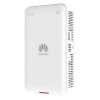
Huawei Access Point AP263.
AP263 is Huawei‘s Wi-Fi 6 (802.11ax) wall plate AP. This AP features high bandwidth, high concurrency, and compact size, facilitating flexible deployment and saving customer investment. It is applicable to indoor coverage in SME markets, such as SMB office, hospitals, and cafes.
Appearance

Ports

1 | GE0/PoE_IN | 2 | GE1 |
3 | USB | 4 | DC 12V |
Table 5-57 Ports on the AP263
| Port | Connector Type | Description | Available Components |
|---|---|---|---|
| GE0/PoE_IN | RJ45 | 10/100/1000M auto-sensing Ethernet electrical port that connects to the wired Ethernet and supports PoE input. | Network cable |
| GE1 | RJ45 | Ethernet electrical port that supports 10/100/1000M auto-sensing and connects to the wired Ethernet | Network cable |
| DC 12V | DC connector | Connects to a 12 V power adapter. | 12 V DC power adapter |
| USB | USB 2.0 Type A | Connects to an IoT terminal to implement IoT applications. | IoT module |
Indicators and Buttons

The indicator is located inside the panel, which turns on after the AP is powered on.
1 | Indicator | 2 | Default |
Table 5-58 Indicators on the AP263
| Silkscreen | Name | Color | Status | Description |
|---|---|---|---|---|
| – | System indicator | Green | Steady on | Default status after power-on. The AP is just powered on and the software is not started yet. |
| Green | Steady on after blinking once | Software startup status. After the system is reset and starts uploading the software, the indicator blinks white once. Until the software is uploaded and started, the indicator remains steady white. | ||
| Green | Slow blinking (0.5 Hz) | The AP is running properly, the Ethernet connection is normal, and STAs are associated with the AP. This state is supported in V200R022C00 and later versions. | ||
| Green | Slow blinking (0.2 Hz) | The AP is running properly, and the Ethernet connection is normal. For V200R022C00 and later versions, this state also indicates that no STA is associated with the AP. | ||
| Green | Blinking once every 0.25s (4 Hz) | Alarm.
| ||
| Red | Steady on | Fault. A fault that affects services has occurred, such as a DRAM detection failure or system software loading failure. The fault cannot be automatically rectified and must be rectified manually. |
Table 5-59 Buttons on the AP263
| Silkscreen | Name | Description |
|---|---|---|
| Default | Reset button |
|
Technical Specifications
Table 5-60 Technical specifications of the AP263
| Item | Specification |
|---|---|
| Installation Type |
|
| Dimensions without packaging (H x W x D) [mm(in.)] | 160 mm x 86 mm x 38 mm (6.30 in. x 3.39 in. x 1.50 in.) |
| Dimensions with packaging (H x W x D) [mm(in.)] | 75 mm x 205 mm x 115 mm (2.95 in. x 8.07 in. x 4.53 in.) |
| Weight without packaging [kg(lb)] | 0.320 kg (0.705 lb) |
| Weight with packaging [kg(lb)] | 0.542 kg (1.195 lb) |
| Storage | NAND Flash 256 MB |
| Console port | BLE console |
| Maximum power consumption [W] | 12 W |
| Maximum heat dissipation [BTU/hour] | 41 BTU/hour |
| Power supply mode |
|
| Rated input voltage [V] | 12 V |
| Input voltage range [V] | 12±10% PoE: 802.3at/af |
| Service port surge protection | PoE port: Differential mode (48 V-RTN): 0.5 kV (1.2/50 us, 42 ohms), criterion B Common mode (8 wires to ground): 6 kV (1.2/50 us, 42 ohms), criterion B |
| Maximum number of physical ports on the entire device | GE (RJ45) x 2, 10M/100M/1000M auto-sensing |
| Long-term operating temperature [°C(°F)] | 0°C to 40°C (32°F to 104°F) (If the altitude is in the range of 1800 m to 5000 m, the temperature decreases by 1°C or 1.8°F every time the altitude increases by 300 m.) |
| Storage temperature [°C(°F)] | –40°C to +70°C (–40°F to +158°F) |
| Long-term operating relative humidity [RH] | 5% RH to 95% RH |
| Long-term operating altitude [m(ft.)] | –60 m to +5000 m (–196.85 ft to +16404.20 ft) |
| Atmospheric pressure [kPa] | 53kPa – 106kPa ETSI 300 019-2-3 |
| Ground | floating ground |
| USB | USB 2.0 (supporting 5 W power supply) |
| BLE | BLE5.0 |
| Radio number | 2 |
| Operating frequency band |
|
| MIMO spatial streams | Radio 0 (2.4 GHz): 2×2 Radio 1 (5 GHz): 2×2 |
| Wi-Fi standard | 2.4G: 802.11b/g/n/ax 5G: 802.11a/n/ac/ac Wave 2/ax |
| Radio interface | Built-in smart antennas |
| Antenna gain | 2.4G: 2 dBi/chain (peak value) 1 dBi (combined gain) 5G: 3 dBi/chain (peak value) 1 dBi (combined gain) BLE: 4 dBi |
| Maximum transmit power | 2.4G: 20 dBm/chain 23 dBm (combined power) 5G: 20 dBm/chain 23 dBm (combined power) BLE: < 10 dBm |
| Singal radio transmit power [dBm] | 2.4G: -10 dBm to 20 dBm/chain 5G: -10 dBm to 20 dBm/chain |
| MTBF [year] | 69.7 year |
| MTTR [hour] | 0.5 hour |
| Frequency stability [ppm] | +/-20 |
| 802.3at power supply description | No function is limited. |
| 802.3af power supply description | The USB function is unavailable. |
| DC power supply description | No function is limited. |